2026
PRISM: A Programming-Free On-Device Multi-task Adaptation Framework for ReRAM-based Computing-in-Memory Accelerator
ACM/IEEE International Conference on Computer-Aided Design (ICCAD) 2026
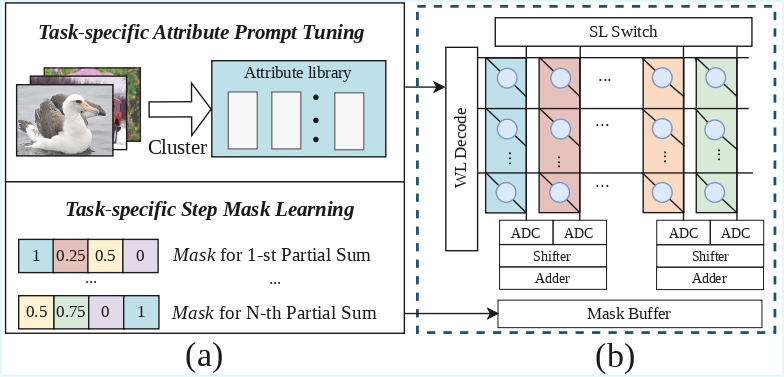
Resistive random-access memory (ReRAM) crossbar arrays, known for high parallelism and energy efficiency, have been widely adopted to accelerate neural network (NN) inference. However, enabling on-device training on ReRAM-based accelerators remains challenging due to their high programming energy, voltage, and limited endurance. In this paper, we propose PRISM, a novel ReRAM programming-free on-device multi-task adaptation framework, enabling task adaptation via novel lightweight task-specific attribute prompt generation and step mask learning, with ultra-lightweight hardware and memory overhead, and eliminating energy-intensive ReRAM cell reprogramming. Specifically, PRISM first builds a task-specific attribute library using the frozen backbone model deployed in ReRAM by clustering representative features from a subset of the target new task dataset. Then, it computes the correlation between each input and the attribute library to generate a prefix prompt embedding. In addition, PRISM learns a novel crossbar column-wise and hardware-friendly step mask for each new task while keeping the backbone fixed. Extensive experiments show that the total training energy of PRISM is only 0.03% of that of all-parameter fine-tuning, with only 3.9% area overhead. Moreover, compared with the state-of-the-art multi-task adaptation method, PRISM improves accuracy by an average of 3.6% in the DeiT transformer model for standard multi-task adaptation datasets.
Read morePRISM: A Programming-Free On-Device Multi-task Adaptation Framework for ReRAM-based Computing-in-Memory Accelerator
ACM/IEEE International Conference on Computer-Aided Design (ICCAD) 2026
Resistive random-access memory (ReRAM) crossbar arrays, known for high parallelism and energy efficiency, have been widely adopted to accelerate neural network (NN) inference. However, enabling on-device training on ReRAM-based accelerators remains challenging due to their high programming energy, voltage, and limited endurance. In this paper, we propose PRISM, a novel ReRAM programming-free on-device multi-task adaptation framework, enabling task adaptation via novel lightweight task-specific attribute prompt generation and step mask learning, with ultra-lightweight hardware and memory overhead, and eliminating energy-intensive ReRAM cell reprogramming. Specifically, PRISM first builds a task-specific attribute library using the frozen backbone model deployed in ReRAM by clustering representative features from a subset of the target new task dataset. Then, it computes the correlation between each input and the attribute library to generate a prefix prompt embedding. In addition, PRISM learns a novel crossbar column-wise and hardware-friendly step mask for each new task while keeping the backbone fixed. Extensive experiments show that the total training energy of PRISM is only 0.03% of that of all-parameter fine-tuning, with only 3.9% area overhead. Moreover, compared with the state-of-the-art multi-task adaptation method, PRISM improves accuracy by an average of 3.6% in the DeiT transformer model for standard multi-task adaptation datasets.
Read more
Dominant-Layer ZO: A Single Layer Dominates Zeroth-Order Fine-Tuning of LLMs
Conference on Neural Information Processing Systems (NeurIPS) 2026
Zeroth-order (ZO) optimization enables memory-efficient fine-tuning of large language models (LLMs) using only forward passes, but it remains unclear how useful adaptation is distributed across layers. In this work, we reveal a surprising phenomenon: ZO fine-tuning is sharply dominated by a single decoding layer. Across multiple LLM families and downstream tasks, fine-tuning this dominant layer alone consistently matches or even exceeds full-model ZO fine-tuning. We further show that the dominant layer is task-agnostic but model-specific, and can be identified before training through a simple inference-only analysis of activation outliers. Specifically, the dominant layer consistently aligns with the first activation-outlier layer in the pre-trained model. To explain this phenomenon, we analyze how perturbation effects propagate under ZO optimization. We find that the dominant layer combines two key properties: high perturbation sensitivity and early placement in the residual stream, allowing perturbation-induced effects to propagate and accumulate through remaining subsequent decoding layers. As a result, this layer produces disproportionately strong and stable optimization signals under forward-only updates. Extensive experiments on LLaMA2-7B and Qwen3-8B across nine benchmarks show that dominant-layer ZO fine-tuning improves average performance over full-model MeZO and LoRA-based ZO fine-tuning while achieving up to 4.52 training speedup.
Read more

Dominant-Layer ZO: A Single Layer Dominates Zeroth-Order Fine-Tuning of LLMs
Conference on Neural Information Processing Systems (NeurIPS) 2026
Zeroth-order (ZO) optimization enables memory-efficient fine-tuning of large language models (LLMs) using only forward passes, but it remains unclear how useful adaptation is distributed across layers. In this work, we reveal a surprising phenomenon: ZO fine-tuning is sharply dominated by a single decoding layer. Across multiple LLM families and downstream tasks, fine-tuning this dominant layer alone consistently matches or even exceeds full-model ZO fine-tuning. We further show that the dominant layer is task-agnostic but model-specific, and can be identified before training through a simple inference-only analysis of activation outliers. Specifically, the dominant layer consistently aligns with the first activation-outlier layer in the pre-trained model. To explain this phenomenon, we analyze how perturbation effects propagate under ZO optimization. We find that the dominant layer combines two key properties: high perturbation sensitivity and early placement in the residual stream, allowing perturbation-induced effects to propagate and accumulate through remaining subsequent decoding layers. As a result, this layer produces disproportionately strong and stable optimization signals under forward-only updates. Extensive experiments on LLaMA2-7B and Qwen3-8B across nine benchmarks show that dominant-layer ZO fine-tuning improves average performance over full-model MeZO and LoRA-based ZO fine-tuning while achieving up to 4.52 training speedup.
Read more
2025
Harmony: A Hardware-Mapping Co-Exploration Framework for Hybrid CIM-based Vision Transformer Accelerator
International Symposium on Quality Electronic Design (ISQED) 2026
🏆 Best Paper Award
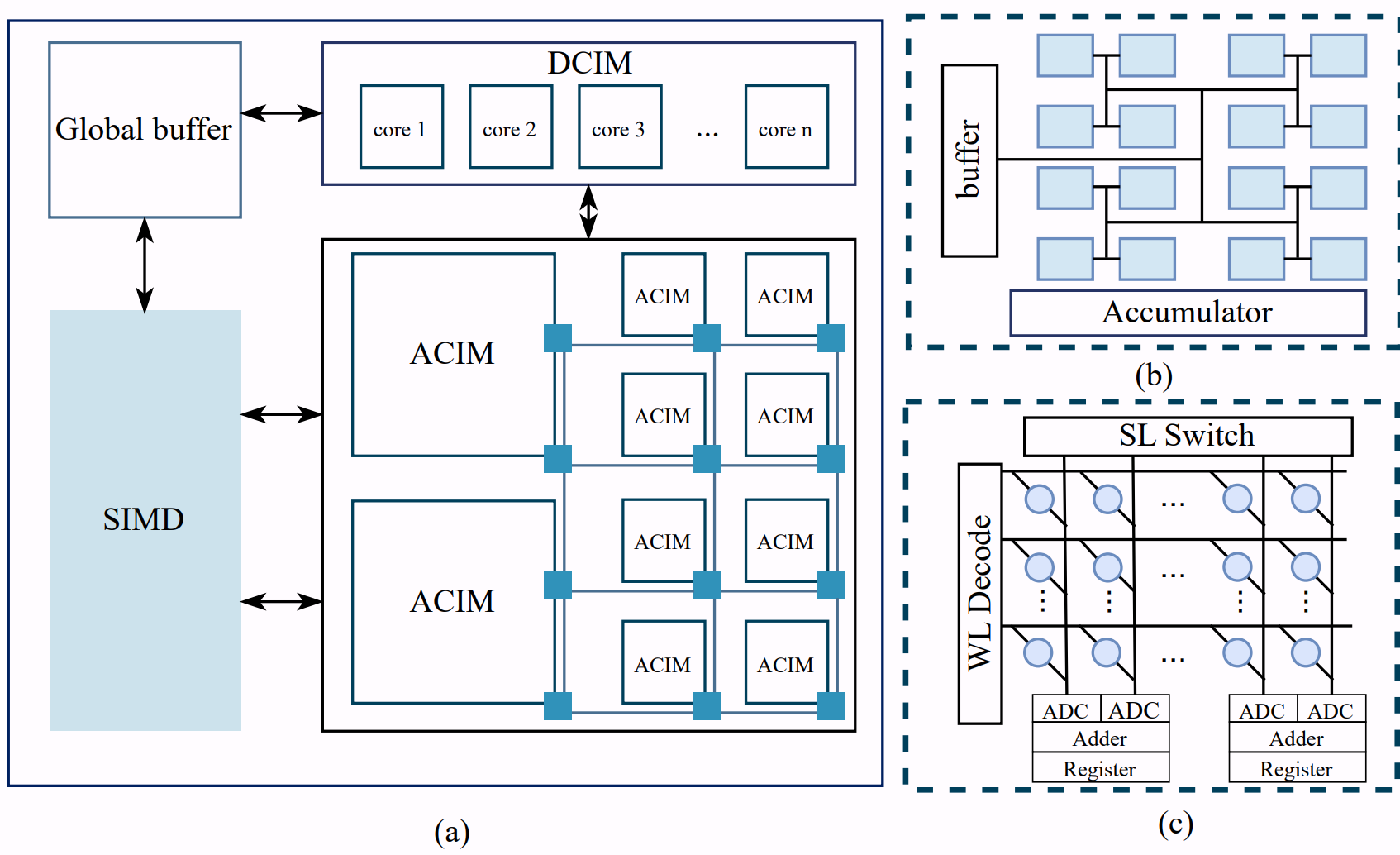
Computing-in-memory (CIM) architectures have successfully enhanced convolutional neural network (CNN) performance, but the automation of high-performance CIM-based transformer accelerators is still challenging. Specifically, the design space of hardware design and mapping is extremely large due to the complex model structure and data flow. To address this problem, we propose Harmony, a hardware and mapping co-exploration framework to optimize the hybrid CIM-based vision transformer accelerator. We define a universal design space representation for implementing vision transformers in CIM-based accelerators that support hybrid and heterogeneous features. The corresponding design space comprises the hardware configuration of CIM macros and their spatial mapping scheme. Furthermore, we propose the knowledge-guided grid search (KGGS) algorithm and improved genetic algorithm (IGA) to boost exploration efficiency. The orthogonal experiment and dominance analysis of KGGS could obtain the exploration probabilities of different parameters and ensure its stability, while the unique order crossover and swapping mutation of IGA could retain relative order to avoid legalization processes during the iteration.
Read moreHarmony: A Hardware-Mapping Co-Exploration Framework for Hybrid CIM-based Vision Transformer Accelerator
International Symposium on Quality Electronic Design (ISQED) 2026
🏆 Best Paper Award
Computing-in-memory (CIM) architectures have successfully enhanced convolutional neural network (CNN) performance, but the automation of high-performance CIM-based transformer accelerators is still challenging. Specifically, the design space of hardware design and mapping is extremely large due to the complex model structure and data flow. To address this problem, we propose Harmony, a hardware and mapping co-exploration framework to optimize the hybrid CIM-based vision transformer accelerator. We define a universal design space representation for implementing vision transformers in CIM-based accelerators that support hybrid and heterogeneous features. The corresponding design space comprises the hardware configuration of CIM macros and their spatial mapping scheme. Furthermore, we propose the knowledge-guided grid search (KGGS) algorithm and improved genetic algorithm (IGA) to boost exploration efficiency. The orthogonal experiment and dominance analysis of KGGS could obtain the exploration probabilities of different parameters and ensure its stability, while the unique order crossover and swapping mutation of IGA could retain relative order to avoid legalization processes during the iteration.
Read more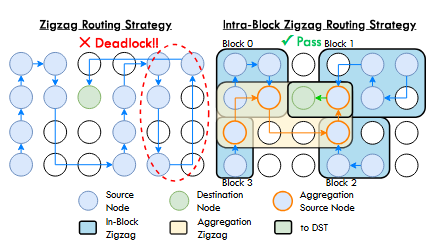
Optimizing Heterogeneous Compute-in-Memory with Hybrid Dataflow and In-Network Reduction for Vision Transformer
International Symposium on Low Power Electronics and Design (ISLPED) 2025
Vision Transformers (ViTs) have shown remarkable success in computer vision tasks, but their computational demands pose significant challenges for efficient deployment. This paper presents an optimization framework for heterogeneous Compute-in-Memory (CIM) architectures that leverages hybrid dataflow and in-network reduction techniques to accelerate ViT inference. Our approach addresses the unique computational patterns of ViTs by combining different dataflow strategies and implementing efficient reduction operations within the CIM network.
Read moreOptimizing Heterogeneous Compute-in-Memory with Hybrid Dataflow and In-Network Reduction for Vision Transformer
International Symposium on Low Power Electronics and Design (ISLPED) 2025
Vision Transformers (ViTs) have shown remarkable success in computer vision tasks, but their computational demands pose significant challenges for efficient deployment. This paper presents an optimization framework for heterogeneous Compute-in-Memory (CIM) architectures that leverages hybrid dataflow and in-network reduction techniques to accelerate ViT inference. Our approach addresses the unique computational patterns of ViTs by combining different dataflow strategies and implementing efficient reduction operations within the CIM network.
Read more2024
OpenC2: An Open-Source End-to-End Hardware Compiler Development Framework for Digital Compute-in-Memory Macro
Design, Automation & Test in Europe Conference (DATE) 2024
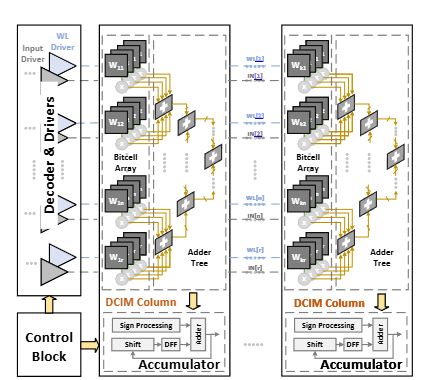
Compute-in-Memory (CIM) has emerged as a promising paradigm to address the memory wall problem in modern computing systems. However, the lack of comprehensive toolchains for CIM macro development hinders its widespread adoption. This paper presents OpenC2, an open-source end-to-end hardware compiler development framework specifically designed for digital CIM macros. OpenC2 provides a complete toolchain from high-level algorithm descriptions to optimized CIM macro implementations, enabling rapid prototyping and design space exploration.
Read moreOpenC2: An Open-Source End-to-End Hardware Compiler Development Framework for Digital Compute-in-Memory Macro
Design, Automation & Test in Europe Conference (DATE) 2024
Compute-in-Memory (CIM) has emerged as a promising paradigm to address the memory wall problem in modern computing systems. However, the lack of comprehensive toolchains for CIM macro development hinders its widespread adoption. This paper presents OpenC2, an open-source end-to-end hardware compiler development framework specifically designed for digital CIM macros. OpenC2 provides a complete toolchain from high-level algorithm descriptions to optimized CIM macro implementations, enabling rapid prototyping and design space exploration.
Read more2023
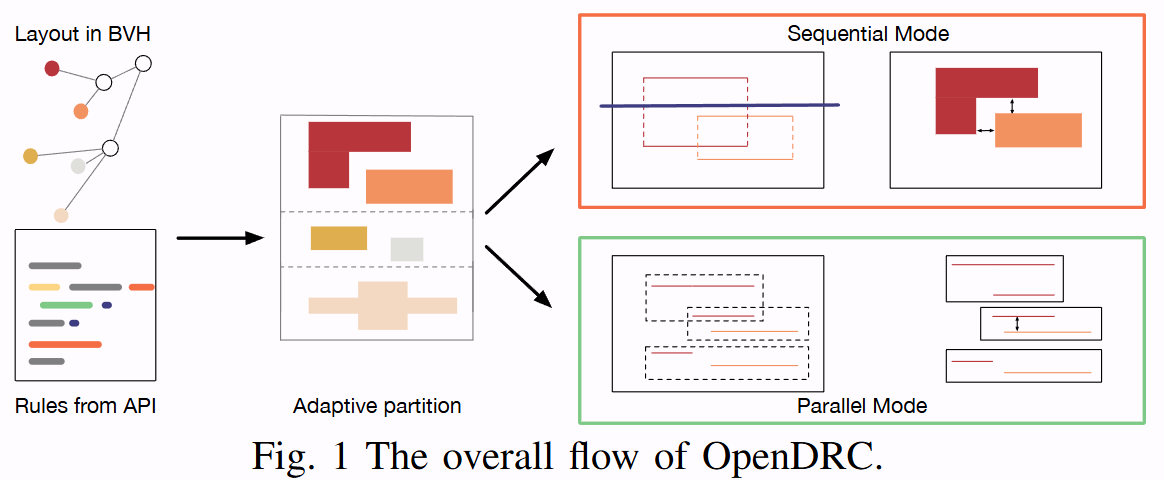
OpenDRC: An Efficient Open-Source Design Rule Checking Engine with Hierarchical GPU Acceleration
ACM/IEEE Design Automation Conference (DAC) 2023
Design Rule Checking (DRC) is a critical step in the VLSI design flow that ensures manufacturability of integrated circuits. Traditional DRC tools face scalability challenges with increasing design complexity. This paper presents OpenDRC, an efficient open-source DRC engine that leverages hierarchical GPU acceleration to achieve significant performance improvements. Our approach utilizes the parallel processing capabilities of GPUs and hierarchical design representation to accelerate DRC operations while maintaining accuracy.
Read moreOpenDRC: An Efficient Open-Source Design Rule Checking Engine with Hierarchical GPU Acceleration
ACM/IEEE Design Automation Conference (DAC) 2023
Design Rule Checking (DRC) is a critical step in the VLSI design flow that ensures manufacturability of integrated circuits. Traditional DRC tools face scalability challenges with increasing design complexity. This paper presents OpenDRC, an efficient open-source DRC engine that leverages hierarchical GPU acceleration to achieve significant performance improvements. Our approach utilizes the parallel processing capabilities of GPUs and hierarchical design representation to accelerate DRC operations while maintaining accuracy.
Read more2022
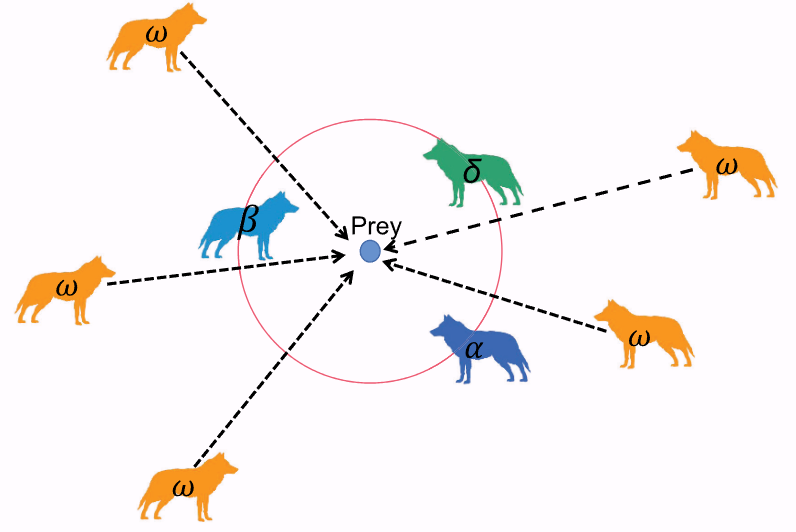
Symmetrical indoor visible light layout optimized by a modified grey wolf algorithm
Applied Optics (AO) 2022
Visible light communication (VLC) systems require optimal LED placement to ensure uniform illumination and reliable communication. This paper presents a modified grey wolf optimization algorithm for designing symmetrical indoor visible light layouts. The proposed approach optimizes LED positioning to achieve balanced illumination distribution while maintaining communication quality, addressing the challenges of indoor VLC system design.
Read moreSymmetrical indoor visible light layout optimized by a modified grey wolf algorithm
Applied Optics (AO) 2022
Visible light communication (VLC) systems require optimal LED placement to ensure uniform illumination and reliable communication. This paper presents a modified grey wolf optimization algorithm for designing symmetrical indoor visible light layouts. The proposed approach optimizes LED positioning to achieve balanced illumination distribution while maintaining communication quality, addressing the challenges of indoor VLC system design.
Read more2021

Analysis on Public Opinion Sentiment Evolution of COVID-19 Based on Weibo Data
WHICEB 2021 PROCEEDINGS 2021
Understanding public sentiment evolution during major events like the COVID-19 pandemic is crucial for effective crisis management. This paper analyzes public opinion sentiment evolution of COVID-19 based on Weibo (Chinese social media platform) data. We employ natural language processing techniques to track sentiment changes over time and identify key factors influencing public opinion during different phases of the pandemic.
Read moreAnalysis on Public Opinion Sentiment Evolution of COVID-19 Based on Weibo Data
WHICEB 2021 PROCEEDINGS 2021
Understanding public sentiment evolution during major events like the COVID-19 pandemic is crucial for effective crisis management. This paper analyzes public opinion sentiment evolution of COVID-19 based on Weibo (Chinese social media platform) data. We employ natural language processing techniques to track sentiment changes over time and identify key factors influencing public opinion during different phases of the pandemic.
Read more